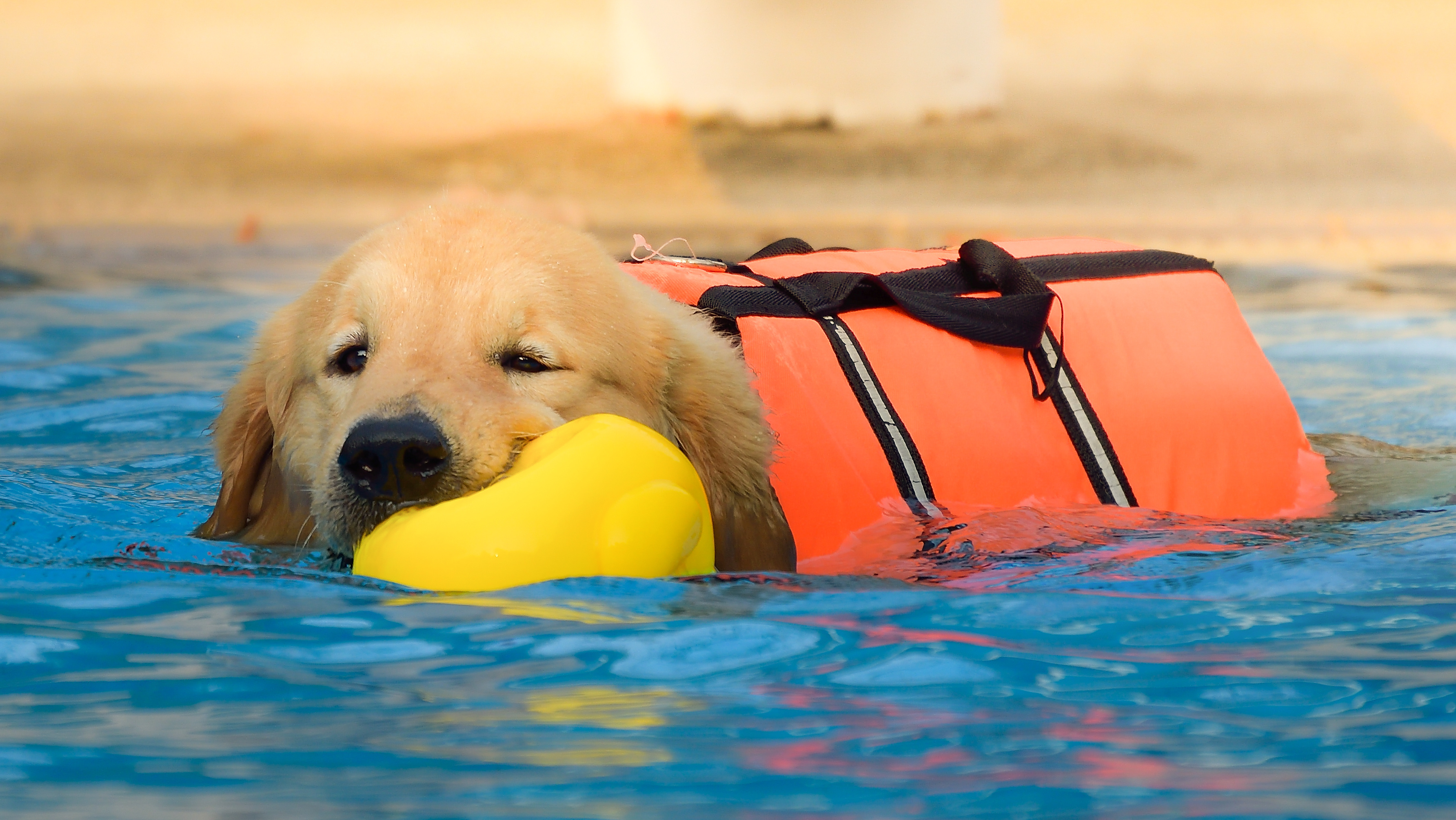
Taking your dog to the pool, the lake, or the beach is not only lots of fun, but it's also great outdoor exercise for you both.
However, whether or not your dog is enthusiastic about playing in the water, you'll need to spot safety risks to keep your dog out of trouble.
Some potentially life-threatening events appear innocent at first glance. But as a prepared dog parent, you'll know how to manage your dog's activities and ensure they play safely in the water.
Some dogs, like Labs and Newfoundlands, are built for swimming, and they're good at it.
Many dogs, however, such as Pugs, Dachshunds, and Bulldogs, are not built for swimming.
But even a natural swimmer is at risk for exhaustion and muscle fatigue that could quickly result in drowning.
Don't assume your dog is safe just because he's enjoying himself.
Everything can change in a heartbeat.
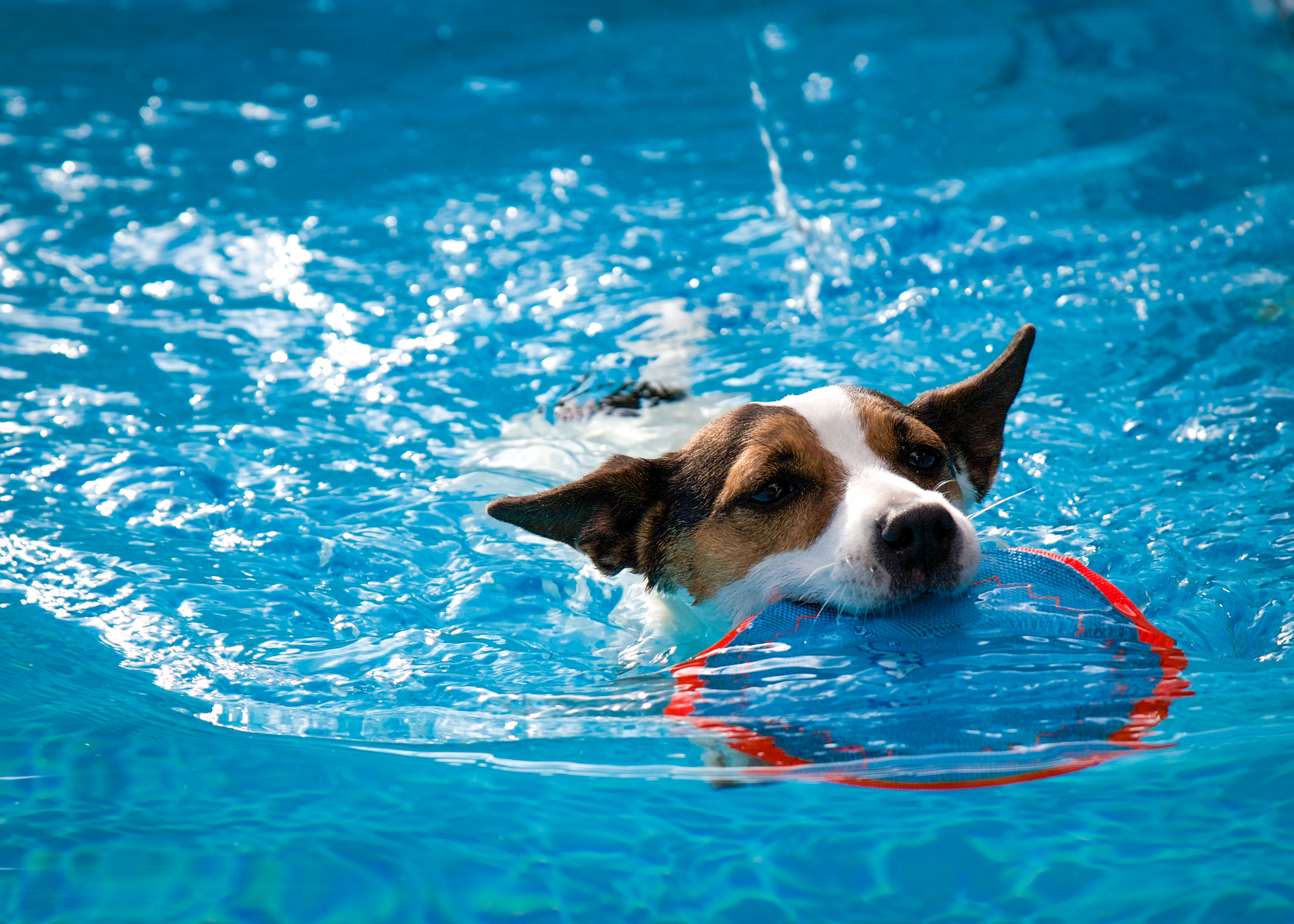
Swimming Safety Rules:
- Before playing in the pool, teach your dog how to get out of the pool without help. Show him the steps and practice finding them from different places in the pool.
- Never leave a swimming dog unsupervised.
- Insist on frequent breaks and rest periods, especially for enthusiastic swimmers.
- Always use a properly fitting life jacket with a handle to protect your dog from muscle fatigue.
- In open water, use a strong long line and life jacket to protect the dog from being overcome by currents.
Water Intoxication
Water intoxication occurs when a dog takes in more water than his body can process. The mineral and electrolyte balance in his body is disrupted and this condition can quickly cause death.
Small dogs and energetic swimmers are more at risk.
Dogs retrieving from water with wide-open mouths are at risk of taking in excess water.
That's why dogs that work in the water are trained to swim with their heads high and mouths closed.
Dogs that bite at the hose and at sprinklers can swallow excessive amounts of water in a short time.
Symptoms of water intoxication include staggering, dizziness, nausea, pale gums, salivation, fainting, and seizures.
THIS IS A LIFE THREATENING EMERGENCY! GET VETERINARY CARE IMMEDIATELY!
How to Prevent Water Intoxication
- Be careful that your dog isn't swallowing water while he is retrieving
- Never leave a swimming dog unsupervised
- Give frequent breaks and rest periods
- Always use a properly fitting life jacket with a handle
- Retrieve only flat objects so that the dog does not have to open his mouth wide to take a round object, risking taking in too much water.
Blue-Green Algae Poisoning
Blue-green algae are actually bacteria often found in ponds, lakes, and even pools during hot, dry weather.
Toxic algae are not always visible. Blooms can be present in water that appears safe.
Toxic algae can cause fatal liver failure if ingested by dogs that are playing in the water. It's also toxic to people.
Get emergency veterinary care as fast as possible.
There is no antidote for algae toxins, but fast, aggressive veterinary treatment may save your dog.
How to Avoid Blue-Green Algae
What to look for: The bacteria can clump together and appear blue, green, brown, or red on the surface of stagnant water. It can also be invisible. It can smell disgusting to people but attractive to dogs.
Why it's dangerous: Ingesting toxic algae causes liver failure in dogs. Symptoms are vomiting, diarrhea, seizures, coma, and death.
What you can do: If your dog likes to play in the water, avoid locations where algae blooms can grow. Keep your dog on a leash when near ponds or low-flow water. Don't let your dog drink from ponds or standing water.
If you think your dog is exposed:
Immediately rinse your dog off with clean water. Direct the dog's head downward if you flush out his mouth so he doesn't swallow the water.
GET EMERGENCY VETERINARY CARE IMMEDIATELY!
Resources
https://m.petmd.com/dog/emergency/common-emergencies/e_dg_drowning
https://m.petmd.com/dog/emergency/common-emergencies/e_dg_cardiopulmonary_resuscitation
https://healthypets.mercola.com/sites/healthypets/archive/2012/07/20/dogs-good-swimmers.aspx
https://healthypets.mercola.com/sites/healthypets/archive/2013/10/28/water-intoxification.aspx
https://www.whole-dog-journal.com/care/water-intoxication-in-dogs/
https://www.merckvetmanual.com/toxicology/algal-poisoning/overview-of-algal-poisoning
https://www.akc.org/expert-advice/news/blue-green-algae-symptoms-tips/
https://www.petpoisonhelpline.com/poison/blue-green-algae/




Responses